Catch the carrier that came back from the dead.
A reincarnated carrier shuts down under one DOT number and re-registers under a new one, leaving its crash history, violations, and unpaid claims behind. FleetRize finds the family resemblance before you fund it.
How do I spot a reincarnated trucking carrier that reopened under a new DOT number?
Look for what does not change when the DOT number does: the business address, phone, officers, name, and trucks. The biggest telltale is the same trucks appearing in inspections under different DOT numbers. Reincarnation Detection checks every application for these links, scores the pattern from 0 to 10, and shows every factor so you can tell a real red flag from a paperwork coincidence.
What is a reincarnated carrier?
Reincarnated carriers, also known as chameleon carriers in federal literature, shut down their operating authority under one DOT number and re-register under a new one, often to escape a poor safety record, unpaid judgments, or an open investigation. The trucks, the officers, and the risk stay the same. Only the number changes.
Regulators have tracked the pattern for over a decade, and it has only become more visible since. Federal auditors have measured how fast it grows and how much riskier it is than ordinary new-entrant risk.
Carriers matching the reincarnation pattern identified by federal auditors, 2005 to 2010.
Share of those carriers later involved in a severe crash, versus other new entrants: three times the rate.
Violations spread across one reincarnating carrier network, exposed in a national television investigation.
FMCSA's identity-proofed registration rollout, built specifically to make reincarnation harder to pull off.
Average annual cargo theft and fraud losses for a single motor carrier. Logistics providers average $1.84M.
How Reincarnation Detection works.
Not a sequence of steps: three aspects of the same identity graph, running on every application.
Map
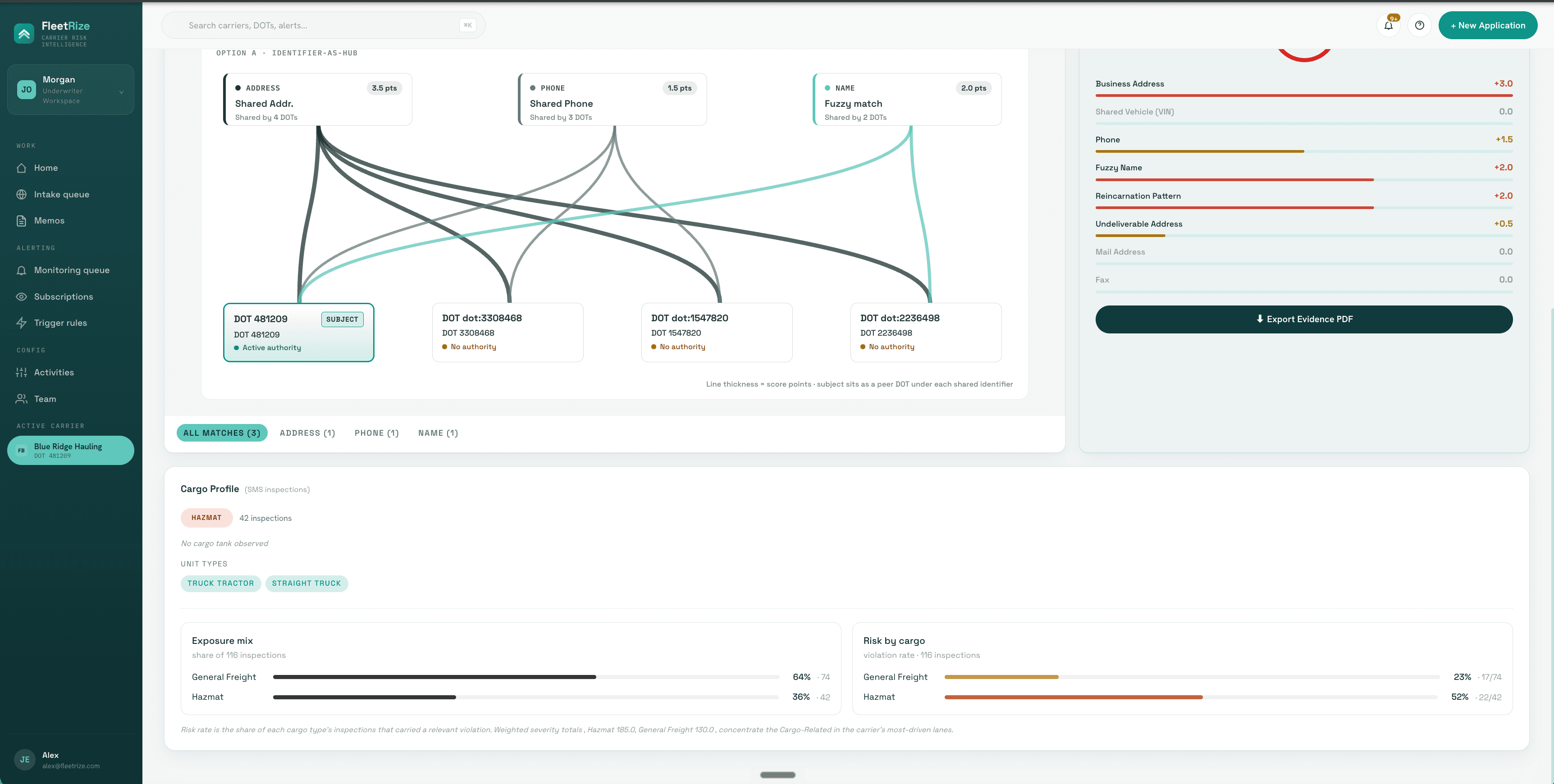
Every application is checked for shared addresses, phones, names, officers, and vehicles across DOT numbers. The biggest telltale: the same trucks showing up in inspections under different DOT numbers.
Score
Each match adds points: a shared business address, a near-identical name, an active reincarnation pattern, an address the mail bounces from. The total is a 0 to 10 score with bands you can act on.
Prove
The related-entity graph shows every link, and one click exports the evidence as a PDF for your file.
Fraud signals, not false alarms.
Many carriers share an address or phone for ordinary reasons, like a permitting service or a process agent. FleetRize does not just flag the overlap. It shows every factor and its weight so a person can tell a real red flag from a paperwork coincidence.
A shared mailbox and a shared terminal look nothing alike once you can see the factors.
The pattern doesn’t stop watching after intake.
Reincarnation risk isn’t intake-only. If a carrier’s band changes, its score jumps, a new related DOT appears, or the reincarnation flag flips, that’s a task in your queue the next morning.
Reincarnated carriers, answered plainly.
What is a reincarnated carrier?
A carrier that shuts down under one DOT number and re-registers under a new one, often to escape a poor safety record, unpaid judgments, or an open investigation. The trucks, the officers, and the risk stay the same.
What are the warning signs?
A shared business address, a shared phone, shared officers, a near-identical name, an address the mail bounces from, and the same trucks in inspections under different DOT numbers.
Is a shared address always a red flag?
No. Many carriers share an address or phone for ordinary reasons, such as a permitting service or a process agent. That is why FleetRize shows each factor and its weight.
Does checking stop after intake?
No. If a carrier's band changes, its score jumps, a new related DOT appears, or the reincarnation flag flips, a task lands in your queue the next morning.
See Reincarnation Detection on a carrier you know.
Your first ten carriers are free. Pull a DOT number you have always wondered about and read its family tree.